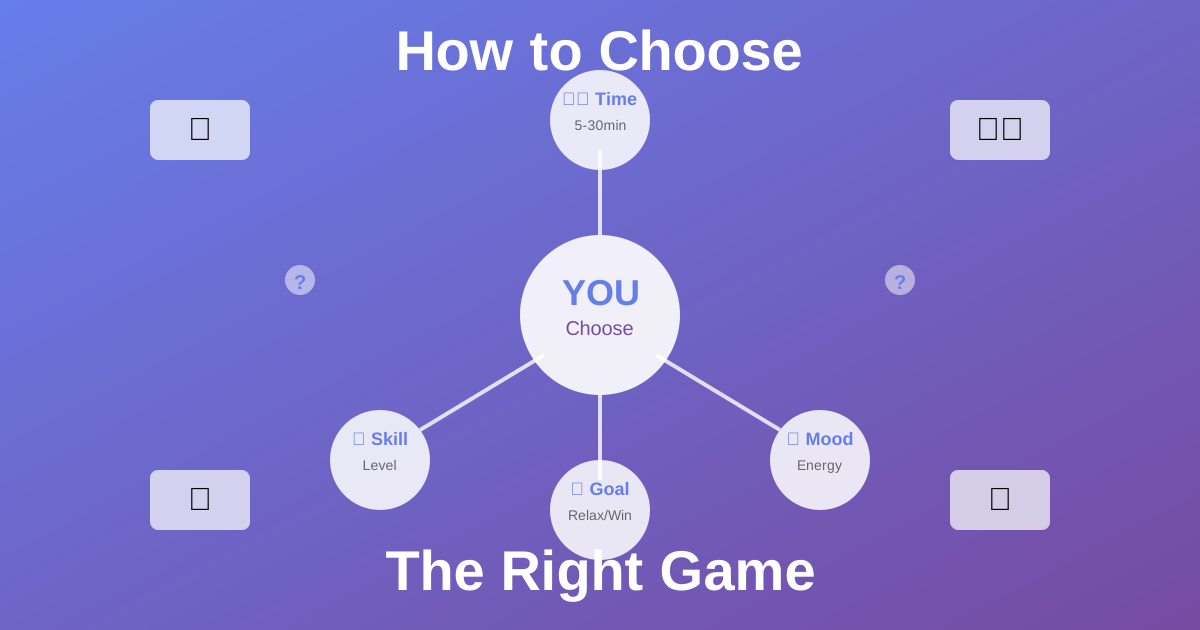
🎯 How to Choose the Right Online Game for You
Staring at a library of 126 free games but not sure which one to play? You're experiencing what psychologists call "choice paralysis"—the overwhelming feeling when presented with too many options. Research by Columbia University professor Sheena Iyengar shows that having more choices actually decreases satisfaction because we spend more time second-guessing our decisions.
The good news? With the right decision framework, you can find the perfect game for your current mood, available time, and gaming goals in under 2 minutes. This guide provides a systematic approach to game selection based on four critical factors: your current mood, available time, skill level, and desired cognitive outcome.
By the end of this article, you'll have a personalized game selection system that eliminates decision fatigue and maximizes gaming enjoyment.
🧠 The 4-Factor Game Selection Framework
Step 1: Identify Your Current Mood
Your emotional state determines which game genres will feel most satisfying. Games that match your mood create flow states (the "losing track of time" feeling), while mismatched games feel frustrating or boring.
Ask yourself: "How am I feeling right now?"
Stressed / Need to Decompress
What you need: Low-stakes games with simple mechanics and immediate feedback. Avoid competitive games that add more pressure.
Best game types:
- Casual Puzzle: 2048 Cupcakes, Bejeweled (relaxing, no time limits)
- Meditative Arcade: Snake, Brick Breaker (repetitive motion = stress relief)
- Creative Sandbox: Pixel Art Creator (no win/lose states)
Avoid: Chess, competitive multiplayer, timed challenges—these add cognitive load.
Energized / Want Competition
What you need: Fast-paced games with clear win conditions and skill-based outcomes. You want to prove yourself.
Best game types:
- Strategy Duels: Chess, Checkers, Reversi
- Speed Challenges: Tetris, Minesweeper (race against the clock)
- Arcade Action: Pac-Man, Space Invaders
Pro tip: Set personal high score challenges to channel competitive energy.
Mentally Sharp / Want a Challenge
What you need: Logic puzzles and strategic games that reward deep thinking. You're in "flow state readiness."
Best game types:
- Logic Puzzles: Sudoku, Nonogram, Crossword
- Pattern Recognition: 2048, Mahjong
- Strategic Planning: Chess, Solitaire
Optimal timing: Morning (9-11am) or late afternoon (3-5pm) when cognitive performance peaks.
Tired / Want Mindless Fun
What you need: Games requiring minimal decision-making with instant gratification. Think "brain off, reflexes on."
Best game types:
- Simple Arcade: Flappy Bird, Dino Run (one-button gameplay)
- Match-3: Candy Crush, Bejeweled (no long-term strategy needed)
- Idle Clickers: Cookie Clicker (passive progress)
Avoid: Anything requiring sustained concentration—you won't enjoy it when fatigued.
Social / Want to Connect
What you need: Multiplayer-friendly games that encourage conversation and shared experiences.
Best game types:
- Turn-Based Strategy: Chess, Tic-Tac-Toe (allows talking between turns)
- Party Games: Memory Match, Trivia (large group compatible)
- Cooperative Puzzles: 2048, Sudoku (team problem-solving)
Pro tip: Games with 5-15 minute rounds work best for social settings—allows rotation and spectating.
Educational / Want to Learn
What you need: Games that build cognitive skills while entertaining—the "productive procrastination" sweet spot.
Best game types:
- Memory Training: Memory Match, Simon Says
- Math Skills: Math Quiz, Number Puzzles
- Vocabulary Building: Crossword, Word Search
- Strategic Thinking: Chess, Checkers
Research-backed: Studies show 15 minutes of daily brain games can improve working memory by 15-20% over 8 weeks.
⏱️ The Time-Based Decision Matrix
Your available time determines which games are practical. Playing a 30-minute strategy game when you only have 5 minutes leads to frustration and incomplete sessions.
| Available Time | Best Game Types | Recommended Games |
|---|---|---|
| 2-5 minutes | Quick arcade, one-button games | Flappy Bird, Dino Run, Snake |
| 5-10 minutes | Casual puzzles, match-3 | 2048, Bejeweled, Tic-Tac-Toe |
| 10-20 minutes | Medium puzzles, strategy lite | Sudoku, Checkers, Minesweeper |
| 20-45 minutes | Deep strategy, complex puzzles | Chess, Mahjong, Nonogram |
| 45+ minutes | Campaigns, marathon sessions | Solitaire Paradise (multi-game), Tetris (marathon mode) |
💡 Pro Tip: The 5-Minute Rule
If you're unsure how much time you have: Choose games with natural 5-minute break points (like match-3 games with level structures). You can quit after one level without feeling incomplete, or continue if time allows.
Avoid: Strategy games like Chess when time is uncertain—mid-game interruptions create decision fatigue.
📊 Skill Level Matching System
Playing games that match your skill level creates flow states. Too easy = boring, too hard = frustrating. Here's how to calibrate:
🌱 Complete Beginner (New to Gaming)
Start with: Games having max 2 control inputs and obvious objectives.
- Perfect first games: Tic-Tac-Toe, Memory Match, Snake
- Progression path: Master controls first (1-2 sessions), then focus on strategy
- Avoid: Games with complex rules (Chess) or fast reflexes (Tetris) until comfortable with basics
🎮 Casual Gamer (30-60 min/week)
Sweet spot: Games you can pick up after a week's break without relearning.
- Perfect games: 2048, Sudoku, Bejeweled
- Why they work: Simple rules, muscle memory persists, no meta-game knowledge needed
- Goal setting: Focus on gradual improvement (beat yesterday's high score by 10%)
🏆 Intermediate Player (2-5 hours/week)
Optimal challenge: Games rewarding pattern recognition and strategic planning.
- Perfect games: Chess, Tetris, Mahjong
- Skill development: Learn 2-3 advanced techniques per week (Chess openings, Tetris T-Spins)
- Competition: Start tracking rankings, compete with friends for motivation
⚡ Advanced Gamer (5+ hours/week)
Challenge requirement: Games with high skill ceilings and competitive scenes.
- Perfect games: Chess (study openings), Tetris (speed modes), Minesweeper (world record attempts)
- Meta-gaming: Study strategy guides, watch top players, analyze your replays
- Goal setting: Join online leaderboards, aim for percentile rankings (top 10%, top 1%)
🎯 The Quick Decision Flowchart
Use This 60-Second Game Selector:
- How much time do you have?
- <5 min → Quick arcade games
- 5-15 min → Casual puzzles
- 15-30 min → Strategy lite
- 30+ min → Deep strategy
- What's your energy level?
- Low → Mindless fun (match-3, clickers)
- Medium → Casual challenge (Sudoku, 2048)
- High → Competitive strategy (Chess, Tetris)
- Are you playing alone or with others?
- Alone → Any category works
- With friends → Turn-based or party games
- What's your goal?
- Relax → Low-stakes puzzles
- Compete → Strategy or arcade
- Learn → Educational games
- Socialize → Multiplayer-friendly
Example Decision Path:
Scenario: "It's 8pm, I have 20 minutes before a meeting, feeling mentally sharp but not stressed, playing alone."
Decision:
- Time = 20 min → Rules out quick arcade, allows strategy lite
- Energy = High → Can handle competitive challenge
- Solo play → Any category works
- Goal = Mental challenge → Strategy or logic puzzles
Perfect game: Checkers (15-20 min per match, strategic, competitive against AI)
🧪 The Rotation Strategy for Long-Term Enjoyment
Research shows that playing 3-4 different games in rotation prevents burnout and maintains engagement better than playing one game exclusively.
Create Your Personal Game Rotation:
Monday/Wednesday/Friday (Weekday Energy):
- Primary game: Strategic challenge (Chess, Sudoku)
- Backup game: Quick stress relief (Snake, 2048)
Tuesday/Thursday (Lower Energy Days):
- Primary game: Casual puzzles (Bejeweled, Memory Match)
- Backup game: Mindless fun (Flappy Bird, Cookie Clicker)
Weekend (Variable Time):
- Primary game: Deep strategy sessions (Chess, Mahjong)
- Secondary game: Multiplayer with friends (Tic-Tac-Toe tournament)
- Chill game: Creative sandbox (Pixel Art)
🎮 Ready to Find Your Perfect Game?
Use the framework above to browse our 126 games strategically. Filter by category, read descriptions, and try 2-3 games that match your current situation.
Browse Games by Category →📌 Common Game Selection Mistakes (And How to Avoid Them)
❌ Mistake #1: Always Playing the Same Game
Problem: You plateau after 20-30 hours and progress stalls, causing frustration.
Solution: Introduce 1 new game every 2 weeks. Keep your favorite as "main game" but explore alternatives to maintain freshness.
❌ Mistake #2: Choosing Games Based on Popularity, Not Fit
Problem: "Everyone plays Chess, so I should too"—but you find it too slow and boring.
Solution: Use the mood/time/skill framework above. The "best" game is the one you enjoy, not what's trending.
❌ Mistake #3: Playing High-Concentration Games When Tired
Problem: You start a Sudoku puzzle at 10pm, get frustrated, and quit gaming altogether.
Solution: Match game complexity to energy level. Save strategy games for peak cognitive hours (9-11am, 3-5pm).
❌ Mistake #4: No Clear Goals or Progress Tracking
Problem: You play aimlessly, never feeling accomplished, leading to boredom.
Solution: Set specific, measurable goals:
- "Beat my 2048 high score (4,832) by 10% this week"
- "Learn 3 Chess openings this month"
- "Complete Sudoku Expert puzzles under 15 minutes"
❌ Mistake #5: Quitting Too Early When Learning Curve Is Steep
Problem: You try Chess, lose 5 games to the AI, and decide "I hate Chess."
Solution: Follow the 10-game rule—play any new strategic game at least 10 times before judging. Skill games feel frustrating at first, rewarding later.
🏆 Conclusion: Gaming Should Always Feel Good
The perfect game isn't determined by ratings, graphics, or what's trending—it's determined by how well it matches your current situation. A 5-minute Flappy Bird session during a coffee break can be just as satisfying as a 2-hour Chess marathon when you have free time.
Use the 4-factor framework whenever you're stuck choosing:
- What's your mood? (Stressed, energized, social, tired)
- How much time do you have? (2-5, 5-15, 15-30, 30+ minutes)
- What's your skill level? (Beginner, casual, intermediate, advanced)
- What's your goal? (Relax, compete, learn, socialize)
Answer these 4 questions in 30 seconds, and you'll find the right game every time—no more decision fatigue, no more buyer's remorse (even though everything's free!), just pure gaming enjoyment.
🚀 Start Your Personalized Gaming Journey
Now that you have the framework, browse our 126 games and apply it. Your perfect game is waiting!
Explore All Games →